Can Pakistan Achieve Economic Stability Without Political Stability?
Pakistan's economy appears to be recovering from crisis, but the question remains whether this recovery is permanent or temporary. Inflation, public debt, foreign exchange reserves, taxation, the energy crisis, unemployment and poverty have remained major economic challenges. These are not new problems; Pakistan has been facing repeated economic crises for many years.
Yet economic stability does not exist in isolation. Political uncertainty and frequent policy changes can influence investor confidence, capital flows and the government's ability to sustain economic policies. Economic reforms require consistency, difficult decisions and long-term policy planning, all of which can become difficult in an unstable political environment. At the same time, economic hardship can also create political pressure.
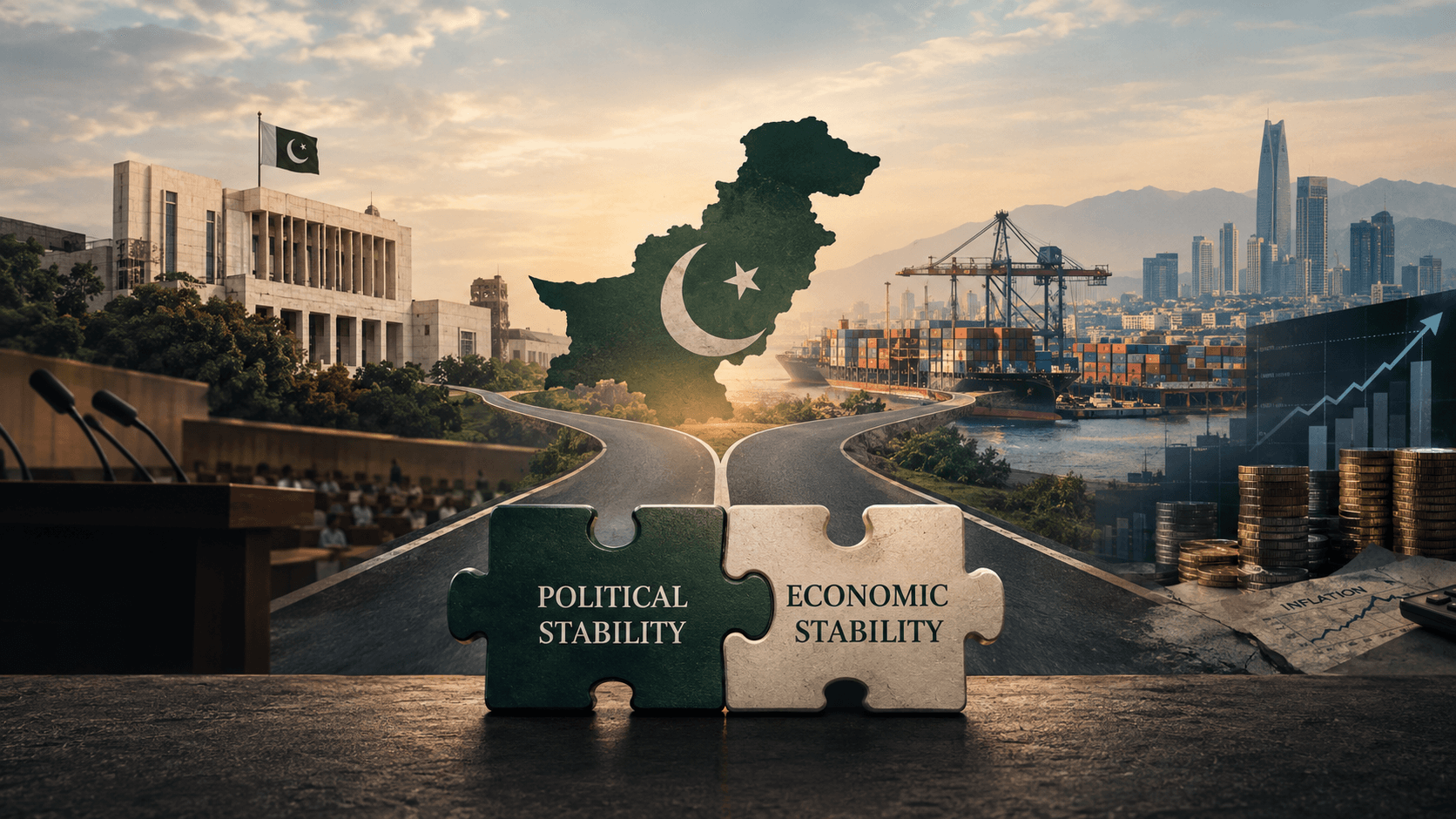
The relationship between political and economic stability is therefore not one-directional. It is a cycle that Pakistan needs to break. This raises an important question:
"Can Pakistan achieve lasting economic stability without political stability?"
Political Stability and Economic Confidence
Political stability is closely related to economic stability. When political uncertainty persists, frequent policy changes can make long-term economic planning difficult and affect overall economic stability. It can also influence investor confidence. When investors lose confidence in the political and economic environment, they may hesitate to make new investments or delay existing plans, which can affect economic growth. Political uncertainty can also contribute to capital flight, as domestic and foreign investors may move their money to safer markets, reducing the funds available for investment and development.
Policy continuity is another important factor in economic stability. When one government introduces economic reforms and a subsequent government abandons or reverses them, long-term economic planning can be disrupted. If economic policy becomes too closely tied to short-term political interests, achieving sustainable economic growth becomes more difficult.
At times, economic decisions taken during a political transition can also leave the incoming government with greater economic pressures and fewer policy options. Moreover, governments may have to take difficult measures to stabilise the economy, such as increasing taxes or energy prices. Although such measures may be necessary for economic reform, they can create public dissatisfaction and political pressure.
When Economic Hardship Creates Political Pressure
The relationship between economic and political stability, however, works in both directions. Just as political instability can weaken the economy, economic hardship can also contribute to political instability. Corruption and inflation are two chronic challenges that can weaken economies, erode public trust and undermine national development. Corruption can distort markets, create artificial shortages, encourage wasteful spending and weaken institutions responsible for economic management.
High inflation also creates serious pressure on households and businesses. It reduces people's purchasing power, making everyday goods and services more expensive and difficult to afford. For public servants and other salaried workers, rising prices can reduce the real value of their incomes. Inflation can also make the economic environment more unpredictable, while higher taxes and rising energy costs can add further pressure. These conditions can increase poverty and inequality, weaken the middle class, slow job creation and affect economic growth.
Economic hardship can consequently lead to public frustration and social unrest, as citizens demand relief from rising living costs and question government policies. Opposition parties may also use economic grievances to challenge the government. Prolonged economic difficulties can therefore weaken public trust in government and increase political pressure.
Governments may then face demands to provide immediate relief, even when their economic situation requires difficult reforms. This can create a conflict between economic necessity and political considerations.
The IMF Dilemma
Pakistan's repeated engagement with the International Monetary Fund (IMF) also highlights the difficult relationship between economic reforms and political stability. When Pakistan faces serious external financing needs and fiscal pressures, it turns to the IMF for financial assistance. IMF programmes require governments to undertake difficult reforms and policy measures aimed at stabilising the economy and improving its long-term sustainability. These measures can include increasing tax revenues, reducing unnecessary subsidies, controlling government spending and reforming the energy sector.
Although such measures may be important for long-term economic stability, they can increase the financial burden on citizens and businesses in the short term. This creates a difficult situation for governments. Economic reforms may be necessary for long-term stability, but their immediate effects can increase public dissatisfaction and political pressure. A government facing political opposition while implementing difficult reforms may find it harder to maintain those policies consistently.
This raises a serious question:
"If governments must constantly respond to immediate political pressure, how can Pakistan maintain long-term economic stability?"
Political Stability Alone Is Not Enough
Political stability can create a better environment for economic reforms, but it cannot itself produce economic stability. A politically stable government can also make poor economic decisions. Therefore, political stability alone cannot guarantee economic stability.
Pakistan needs productive investment that can expand its economic capacity. Exports should be improved, while unnecessary imports should be reduced to minimize the trade deficit. Tax reforms should be introduced, and tax collection should be handled fairly across all sectors. Energy-sector reforms are also necessary to make the energy system more efficient, reliable, competitive and sustainable.
Institutions should function efficiently, fairly and accountably. When institutions operate transparently and provide a predictable environment for businesses, they can attract more Foreign Direct Investment (FDI), which can contribute positively to economic growth. Sustainable debt management is another important factor in protecting the economy. When a government manages its debt responsibly, it can reduce financial pressure, strengthen economic confidence and create a more stable environment for businesses and investment.
Therefore, political stability should be viewed as an important condition for sustained economic reform rather than a complete solution to economic instability.
Neither economic stability nor political stability can be achieved through one factor alone. The two are connected in a cycle that Pakistan needs to break. Pakistan needs continuity in policymaking, regardless of changes in government, so that economic reforms are not repeatedly disrupted by political uncertainty.
The challenges of any country cannot be solved overnight. Pakistan needs long-term planning in which political governments, stakeholders and institutions perform their roles towards common economic goals. Political stability can provide space for this process, but sustained economic stability ultimately depends on how effectively that opportunity is used.