
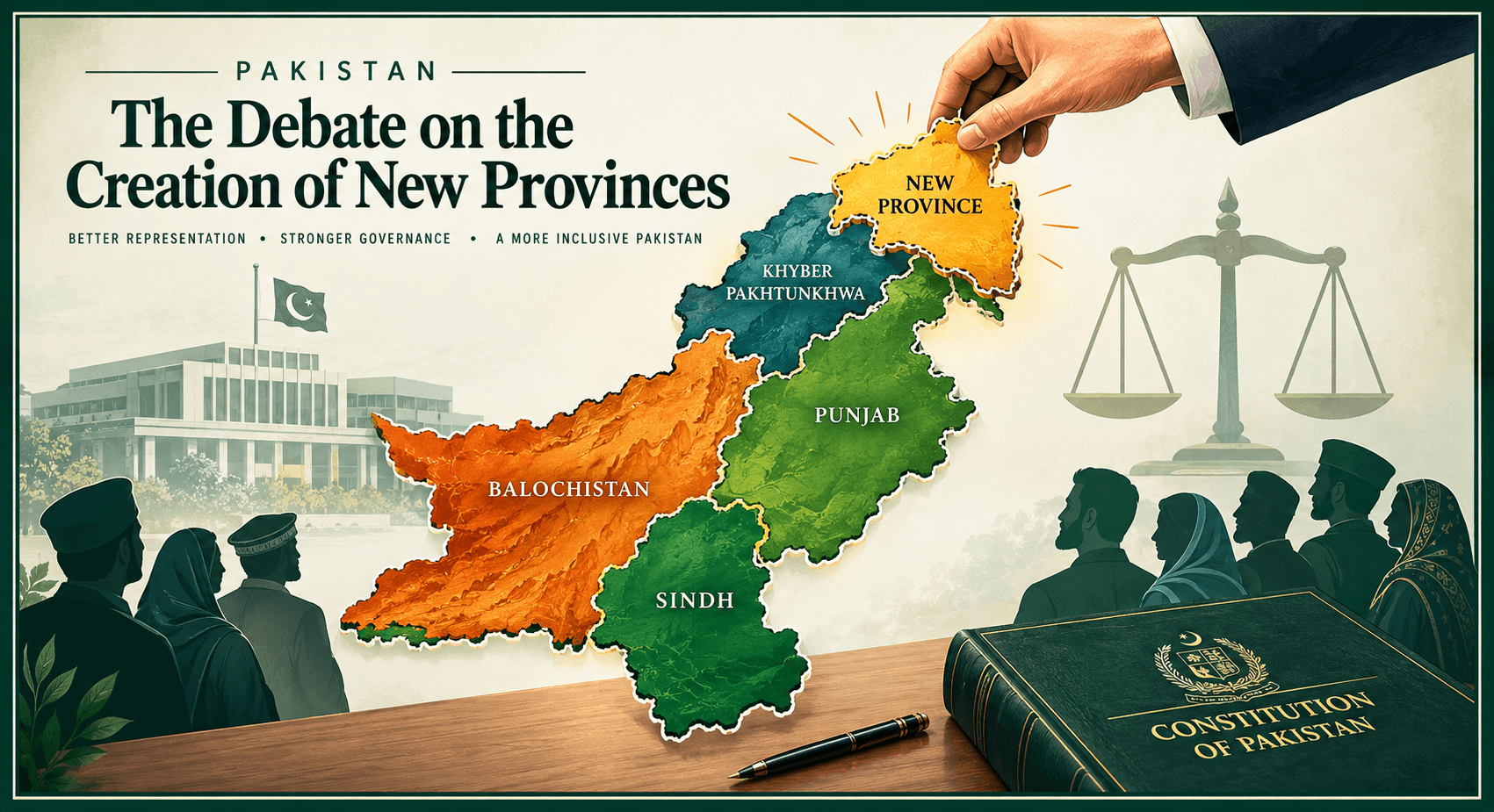
The debate over creating new provinces in Pakistan is not new, but it has gained renewed significance as questions of governance, representation and regional inequality continue to dominate public discourse. The demand for new provinces arises partly from the growing needs of neglected and under-administered regions. When a single provincial government is responsible for a vast territory and a large number of cities, effective administration can become increasingly difficult. Where existing administrative structures have failed to respond adequately to the needs of these regions, the demand for new provinces emerges as a possible means of restructuring governance and improving service delivery.
Administrative and regional disparities have given rise to demands for the creation of new provinces, including South Punjab, Bahawalpur, Hazara and many other proposals. In 2012, the National Assembly passed a resolution supporting the creation of South Punjab as a new province to address the region’s administrative, political and economic concerns. The same year, the Punjab Assembly unanimously passed separate resolutions supporting the creation of South Punjab and the restoration of Bahawalpur’s provincial status. More recently, in December 2025, the Khyber Pakhtunkhwa Assembly unanimously passed a resolution urging the federal government to initiate the constitutional process for establishing Hazara province. In September 2026, the Sindh Assembly adopted a resolution rejecting proposals to divide the province or alter its territorial boundaries.
Unlike the Sindh Assembly, which has recently taken a clear position on the issue, the Punjab and Khyber Pakhtunkhwa assemblies have not taken a similar recent position on the broader question of creating new provinces. The creation of a new province is not merely a political decision; it also requires a constitutional process. Article 239(4) of the Constitution provides that a constitutional amendment altering the limits of a province cannot be presented to the President for assent unless it has first been passed by at least two-thirds of the total membership of the concerned Provincial Assembly. This makes the support of the existing provincial assembly an important part of the constitutional process for creating a new province.
Pakistan’s provincial structure has remained largely unchanged for decades, while its population and administrative needs have increased greatly. Smaller provinces could make administration easier, especially in areas that are far from provincial capitals. New provinces could help neglected regions receive better governance and greater attention from the government. In smaller administrative units, accountability could improve, and decisions could be made more quickly and fairly. Political representation could also increase through provincial assemblies, cabinets, courts and ministries. Separate departments for health, education, police and other services could focus more closely on local needs and improve service delivery. In this sense, supporters view the creation of new provinces not merely as an alteration of boundaries, but as an opportunity to make governance more accessible, responsive and representative.
However, the creation of new provinces also raises several concerns that cannot be ignored. New provinces would need new assemblies, ministries, courts and secretariats, which could place a financial burden on Pakistan. Setting up these institutions would require substantial public expenditure. After the 18th Amendment, provinces gained greater powers and autonomy, but many still rely heavily on the federal government for funds and revenue-sharing. Creating more provinces could therefore increase financial pressure on the federal government. Moreover, demands for new provinces may sometimes be driven by political interests rather than genuine administrative needs.
Yet the creation of new provinces may not be the only way to improve administration and governance in Pakistan. If the existing system fails to deliver, and new provinces follow the same system, how will administration actually improve? There is therefore a need to change the way the system works. In large cities, metropolitan corporations should be strengthened, while effective local government institutions should be established across the country to reduce the distance between the government and the people. These institutions should focus on important local issues such as health, education, sanitation, roads and municipal services.
The creation of new provinces could be a good option if they are able to generate sufficient revenue to meet their own expenses and reduce their dependence on the federal government. Financially strong provinces could provide better services without placing an excessive burden on Pakistan’s economy. However, empowering local governments could improve service delivery without the high administrative costs of creating new provinces. Political parties should sit together and develop a national consensus on the issue instead of treating the demand for new provinces merely as a political matter. The views of people in the affected regions should also be considered, and public support should be assessed before any major decision is taken.
The creation of new provinces in Pakistan is a complex issue that requires careful consideration of both its benefits and challenges. The debate has emerged from the growing population and the need for better administration and governance in underrepresented areas. New provinces could improve administration, representation and service delivery, but they could also create significant financial and administrative costs. New provinces can be useful if they are financially viable, but simply creating new provinces will not solve governance problems if the same inefficient system continues. Stronger and more empowered local governments are also necessary.
New provinces may be part of the solution, but administrative reforms and stronger local governments are essential for improving governance. Ultimately, the success of any administrative reform should be measured not by the number of provinces, but by how effectively the government serves its people.