Is Social Media Changing How Pakistanis Think?
Introduction
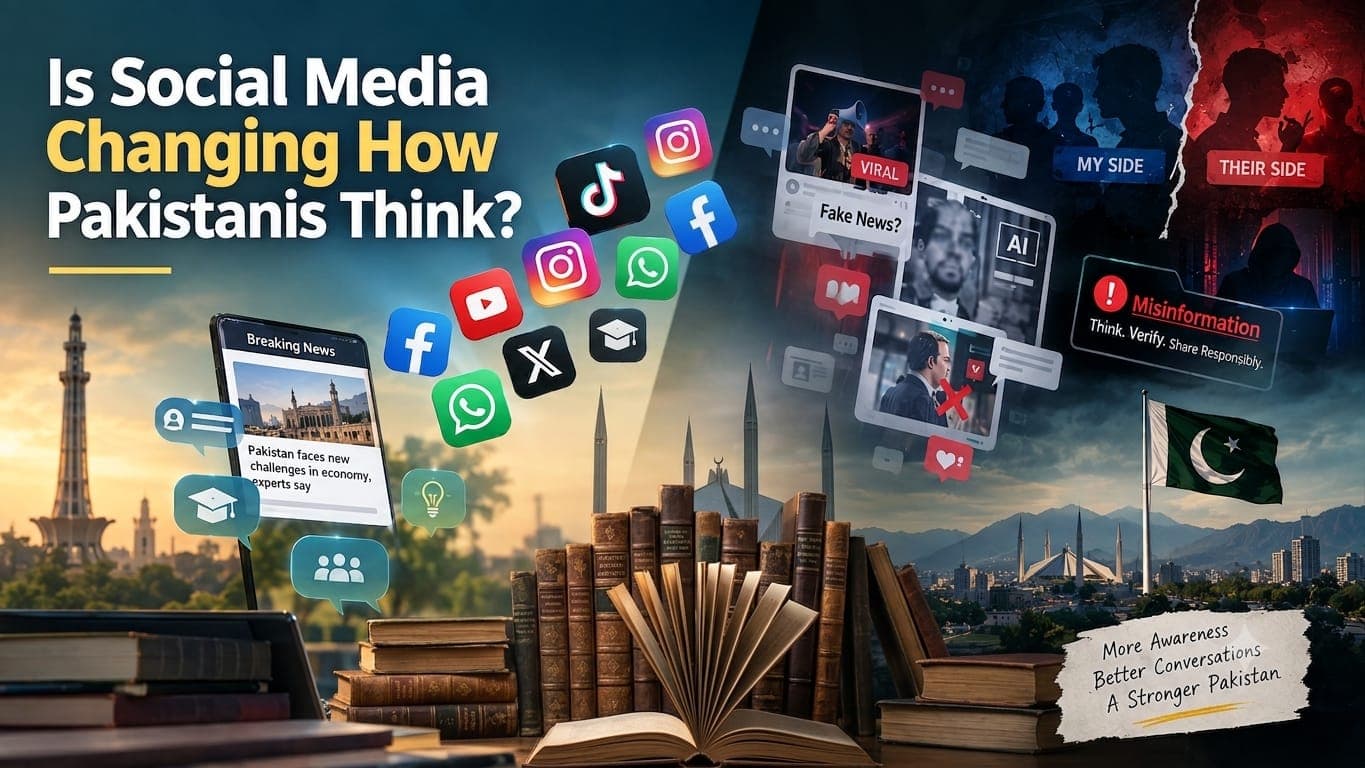
Social media has become an important part of everyday life in Pakistan. From getting news and sharing opinions to watching videos and following public figures, millions of people spend a large part of their day on social media. There are many social media platforms, including Facebook, X, TikTok, Instagram, YouTube and WhatsApp, through which people receive information and discuss national issues.
Many national issues are now highlighted on social media rather than through traditional media. Unlike traditional media, social media allows people to express their opinions directly and participate in discussions without depending entirely on established media institutions. This has contributed to a shift from traditional media towards social media as a source of information and public discussion.
Are we simply consuming more information, or is social media changing how we think?
How Social Media Changed the Way We Get Information
Social media has changed the way people get information. Information reaches people faster, and news and events can spread within minutes. People can access information even while living in remote areas. Ordinary citizens who do not get the opportunity to access traditional media can express their opinions on social media.
On traditional media, information may be limited, while on social media, people can learn about different issues, including social, educational, political and technological matters. Social media has also proved useful for educational content, especially for young people. Students can access information on almost any educational topic, which can make their studies easier.
More information does not necessarily mean better-informed people; the quality of information matters.
From Information to Opinion
People see information on social media and then form opinions or judgments based on what they see. Some content creators may focus more on gaining views and engagement than on providing complete and accurate information. They may use short videos, attention-grabbing headlines or emotional content to attract audiences and make their posts go viral.
As a result, people may form opinions without knowing the full story or understanding the background of an issue. Political discussions can also become emotionally charged as users compete for attention and support. There is a clear difference between knowing about something and understanding it, but people may not always take the time to examine the background or verify the information before expressing their judgments.
The Rise of Echo Chambers
People often follow pages and accounts that match their existing beliefs. As a result, they may repeatedly encounter similar content, while content that challenges their views may receive less attention in their feeds. This can create an environment in which people become more confident in their existing beliefs without considering different perspectives.
This raises an important question: Has political debate become more polarised because people increasingly interact within separate online groups?
In politics, social media can create separate groups with different viewpoints, each following its own preferred narrative or agenda. This can contribute to political polarisation and make it more difficult for people to understand opposing viewpoints. People may become more focused on supporting their own group and rejecting opposing opinions without taking the time to understand them.
Misinformation and the Problem of Trust
When everyone becomes a source of news, misinformation can spread easily. People may spread false information or post misleading headlines to attract attention. Old videos can be presented as new, which can mislead people. Artificial Intelligence (AI)-generated content has also created new challenges, as edited or manipulated videos of public figures can be created and shared on social media to gain views and attention. People may also share information without checking its source, which can contribute to the spread of propaganda or misleading narratives.
Pakistan has responded legally to the problem of false information online. The Prevention of Electronic Crimes (Amendment) Act, 2025 introduced Section 26A, which deals with the intentional dissemination of false or fake information through an information system when the person knows or has reason to believe that it is false and it is likely to cause fear, panic, disorder or unrest. The provision carries a punishment of up to three years' imprisonment, a fine of up to Rs2 million, or both.
Source: Prevention of Electronic Crimes (Amendment) Act, 2025
However, the existence of a law alone cannot solve the problem of misinformation. People also need to develop the habit of checking sources and verifying information before sharing it.
The Positive Side of Social Media
Social media highlights many social problems and brings attention to issues that may receive limited coverage in traditional media. Cases of violence and abuse, including sexual violence against children, can receive wider public attention when they are shared on social media. Issues that may have received limited attention in the past can reach a much larger audience, creating public awareness and encouraging discussion about the need for protection and justice.
Social media also supports humanitarian campaigns and can help small businesses and content creators reach a wider audience. It can connect people during emergencies when individuals need financial or other forms of support. People can share their situations on social media, bringing attention to their problems and helping them reach those who may be willing to provide assistance.
Social media has therefore become an important platform for highlighting social issues, supporting people in difficult situations and bringing important matters into public discussion.
The Need for Critical Thinking
Social media can be used to form opinions, but information should be verified before it is shared. It should be checked against different sources, and understanding the background of a story is more important than sharing it immediately. People may also use emotional content to attract attention, so it is important to avoid reacting to such content without understanding the facts.
The same information can be interpreted in different ways, which is why people should consider different perspectives before forming or expressing their opinions. Being honest and responsible in expressing opinions is equally important.
Conclusion
Social media is a tool, not a thinker. It can influence how Pakistanis receive information and form opinions, but it does not completely determine what they think. How people use it matters. Social media can broaden awareness and give people a voice, but without responsibility, information sharing can also reinforce misinformation and division. Ultimately, its impact depends not only on the technology itself but also on how responsibly people use it.