Why Do So Many Pakistani Children Still Remain Out of School?
Education is often seen as one of the most important foundations for a country’s social and economic development. Yet, in Pakistan, many children still remain outside the school system. While access to education has improved in some areas, poverty, limited access to schools, social and household pressures, and difficulties in continuing education can prevent children from attending regularly or completing their schooling. This raises an important question: why do so many Pakistani children still remain out of school, and what are the main factors keeping them away from education?
The Scale of the Problem
The scale of Pakistan’s education challenge remains significant. According to the latest Household Integrated Economic Survey (HIES) 2024–25, 28% of children aged 5–16 are out of school, compared with 30% in the previous survey. The survey defines out-of-school children as those who have never attended school as well as those who attended but later dropped out.
UNICEF currently estimates that around 25.1 million children aged 5–16 are not attending school. Punjab has the largest absolute number, with about 9.7 million, followed by Sindh with 7.4 million, Khyber Pakhtunkhwa with 4.5 million, and Balochistan with 3.5 million. The proportions also vary considerably between provinces, with Balochistan facing the most severe level of exclusion. These figures show that although Pakistan has made some progress, millions of children are still missing out on formal education.
Why Do Children Remain Out of School?
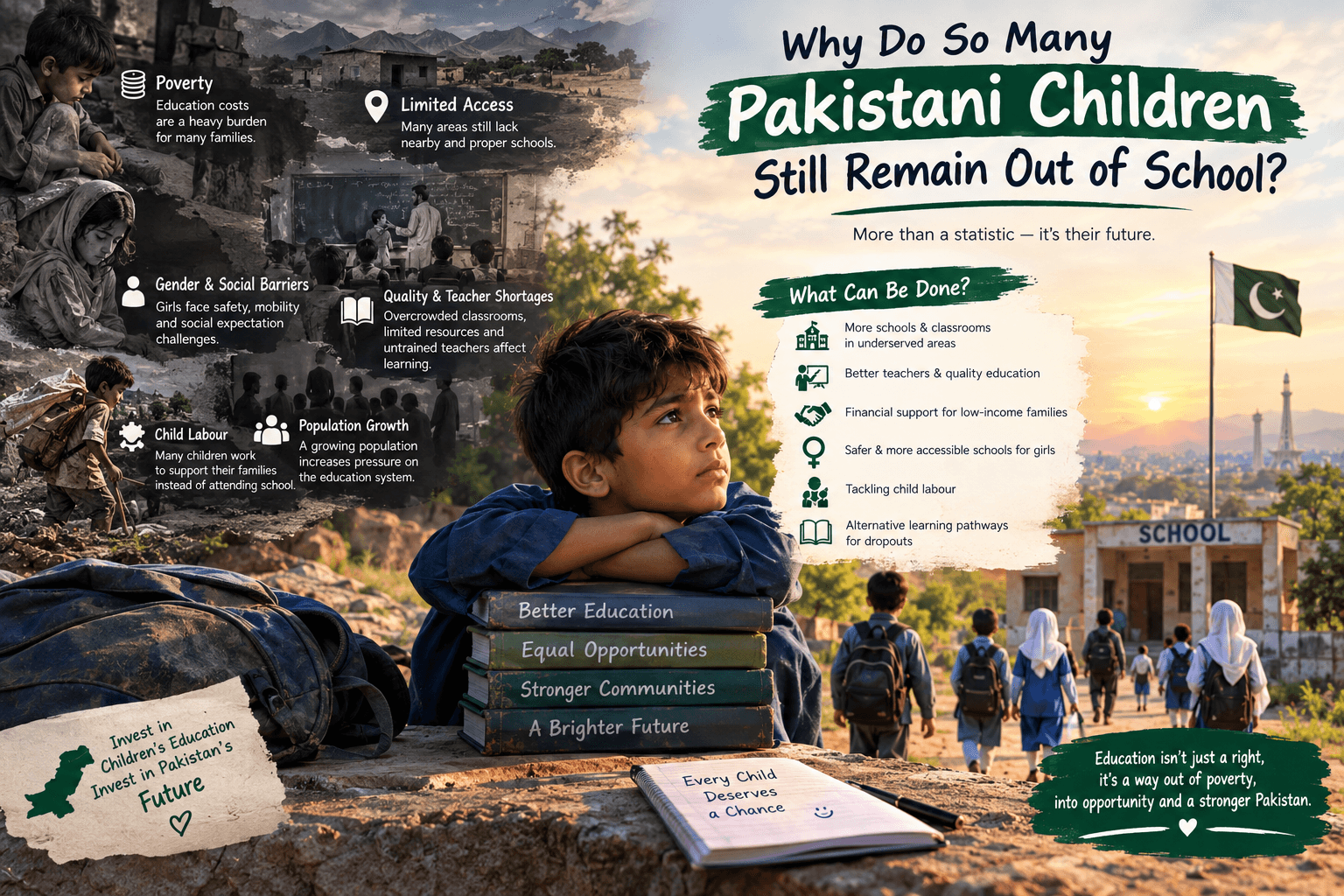
There is no single reason why children remain out of school. For many families, poverty makes education difficult even when public schooling is available. Expenses such as transport, uniforms, books and other necessities can become a burden. In some areas, children also have limited access to schools, particularly beyond the primary level. Girls may face additional barriers related to safety, mobility and social expectations. At the same time, teacher shortages, limited infrastructure and concerns about education quality can discourage families from keeping children in school. These factors often overlap, leaving children from poorer and underserved households facing several barriers at the same time.
Quality of Education and Teacher Shortages
Another important factor is the quality of education itself. Having a school nearby does not always mean that children receive a good education. Teacher shortages, overcrowded classrooms, limited learning materials and inadequate facilities can affect the learning environment. A lack of qualified and trained teachers can also make effective teaching more difficult, particularly in underserved areas. When children struggle to learn or families do not see clear benefits from schooling, they may be less likely to continue their education. Addressing the out-of-school problem therefore requires not only bringing children into classrooms but also improving the quality of education they receive.
Gender and Social Barriers
Gender and social expectations can also make it harder for girls to enter or remain in school. UNICEF reports that gender disparities are particularly visible in Sindh and Khyber Pakhtunkhwa, where girls make up a larger share of children who are out of school. Concerns about safety and mobility, along with a lack of privacy and basic facilities, can become greater barriers as girls grow older.
A recent UNICEF example from Lasbela in Balochistan also shows how school conditions can affect girls’ enrolment. At one girls’ school, concerns about privacy, water and sanitation, and an incomplete boundary wall had discouraged parents from sending their daughters. After improvements were made, enrolment increased from 30 to 70 students. While this is a single school example rather than a national trend, it illustrates how the school environment can influence families’ decisions about girls’ education.
Child Labour and Household Responsibilities
Child labour is another factor that can keep children away from school. For families facing financial difficulties, a child’s earnings or contribution to household work may become more important than continuing education. Boys may be drawn into agricultural or informal work, while girls can face household responsibilities that interfere with schooling. Once children leave school to work or take on substantial household duties, returning to education can become increasingly difficult. This can create a cycle in which short-term economic pressures reduce a child’s chances of gaining the education and skills needed for better opportunities later in life.
Population Growth and Pressure on Education
Pakistan’s growing population also puts additional pressure on its education system. With a population of more than 255 million and annual population growth of around 1.6%, the number of children requiring access to education continues to increase. The education system therefore has to address existing gaps while preparing for the needs of a large and growing young population.
As more children reach school-going age, governments need to expand classrooms, recruit and train teachers, provide learning materials and improve school facilities. If education services do not expand alongside population growth, existing problems such as overcrowding, teacher shortages and limited access can become more difficult to address. Population growth does not by itself cause children to remain out of school, but it increases the scale of the challenge facing the education system.
What Can Be Done?
Reducing the number of out-of-school children will require a long-term effort rather than a single solution. More schools and classrooms are needed in underserved areas, but equal attention should be given to teacher recruitment, school facilities and the quality of learning. Financial support for low-income families can help reduce the economic pressure that keeps children away from school, while safer and more accessible schools can encourage more girls to continue their education.
For children who have already dropped out, alternative learning programmes can provide another opportunity to return to education. UNICEF reported that more than 71,000 out-of-school adolescents enrolled in accelerated learning pathways in 2025, showing how alternative routes can help reconnect young people with education.
Conclusion
Pakistan’s out-of-school children problem is too large to be explained by a single factor. Poverty, child labour, limited access, gender and social barriers, weaknesses in education quality, and pressure from a growing population all contribute to the challenge in different ways. With an estimated 25.1 million children aged 5–16 currently out of school, the scale of the problem remains significant.
The challenge is not only to bring children into classrooms, but also to ensure that they stay, learn and complete their education. This requires sustained investment, better-targeted support for disadvantaged communities, stronger schools and teachers, and greater attention to children who have already dropped out. UNESCO’s 2026 education report similarly emphasizes that lasting progress requires a combination of system-wide reforms, targeted support, equitable financing and long-term commitment rather than a single quick solution.
For Pakistan, reducing the number of children outside the education system will be an important step towards improving human development and creating better opportunities for the country’s young population. The question is not simply how many children can be enrolled, but whether the education system can provide them with the opportunity to learn, continue their studies and build a better future.