
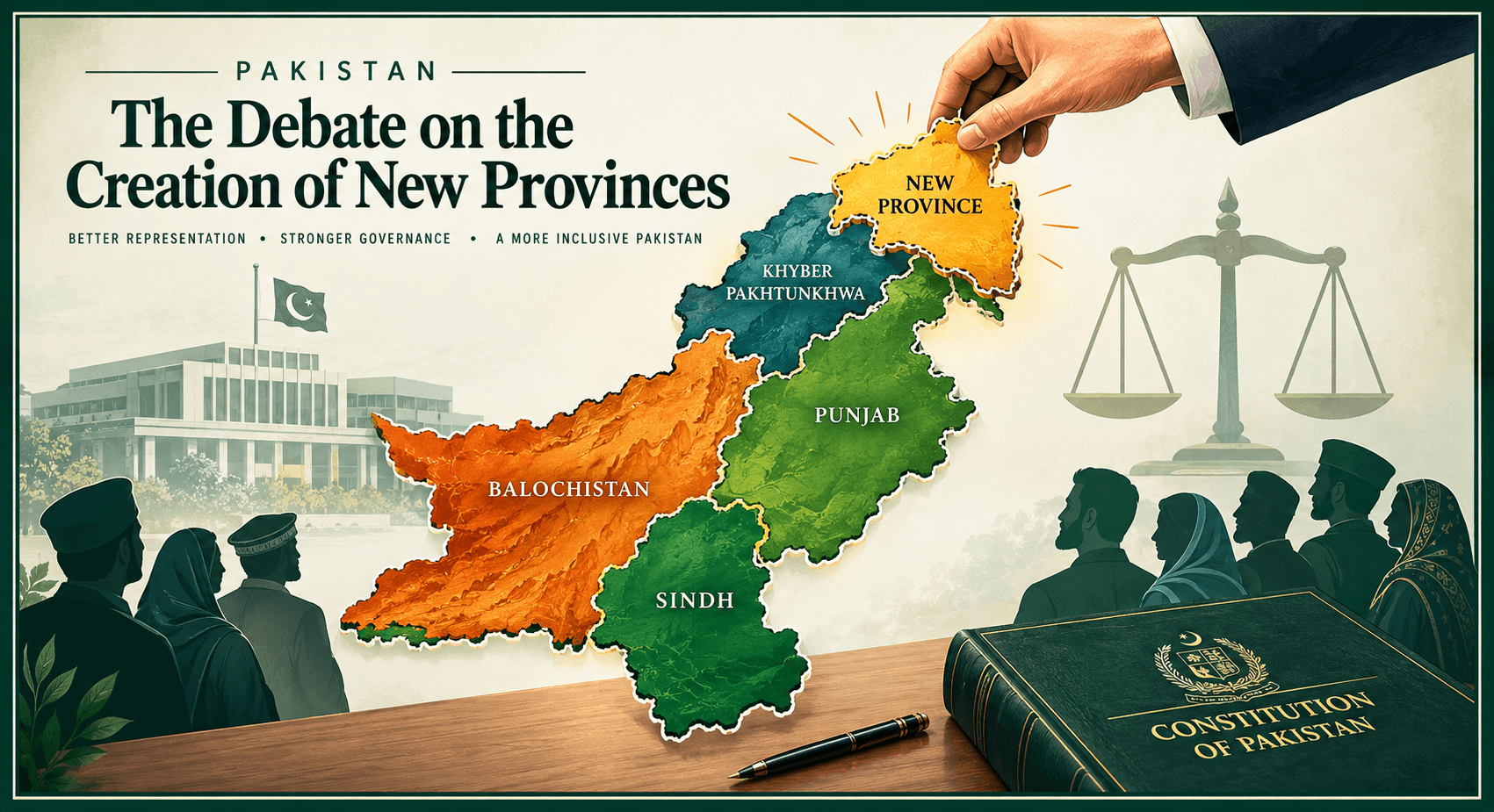
Would New Provinces Really Improve Governance in Pakistan?
The debate over creating new provinces in Pakistan has returned repeatedly, particularly in relation to South Punjab and other regions that feel politically or administratively neglected. Supporters argue that smaller provinces would bring government closer to the people, improve representation and make public services more responsive. Opponents, however, warn that creating new provinces could increase administrative costs without solving the deeper problems of governance.
The important question, therefore, is not simply whether Pakistan needs more provinces. It is whether new provinces would actually improve governance.
Pakistan's administrative challenges are real. Large populations, uneven development, weak public institutions, political interference and limited administrative capacity have made it difficult for governments to provide equal access to health, education, infrastructure and other essential services. In such circumstances, the idea of smaller administrative units can appear attractive.
A smaller province could potentially make government more accessible. Provincial governments would have a closer relationship with the communities they serve and could focus their policies on local economic and social conditions. Regions that believe they receive inadequate attention from existing provincial capitals could gain greater political representation and administrative authority.
South Punjab is a prominent example. Its supporters have long argued that the region deserves greater administrative attention and a stronger political voice. A separate province could, in theory, allow its government to prioritise the region's particular needs rather than competing for attention within a much larger province.
But creating a new province does not automatically create better governance.
A new provincial capital, secretariat, departments, assemblies and administrative structures would require substantial financial resources. Pakistan already faces serious fiscal pressures. If a new province simply reproduces the same bureaucratic weaknesses, political interference and inefficient institutions that exist elsewhere, citizens may see little improvement in their daily lives.
There is another important issue: decentralisation should not stop at the provincial level.
Pakistan's Constitution already provides a framework for local governments, yet local institutions have often struggled to receive consistent political and financial authority. If power is transferred from Islamabad to provincial capitals but does not reach districts, towns and villages, ordinary citizens may remain just as distant from government as before.
This is why the debate about new provinces should be connected to the larger question of local governance.
Imagine creating a new province but leaving schools without teachers, hospitals without adequate staff, municipalities without resources and local representatives without meaningful authority. The map would change, but governance would not.
New provinces can therefore be part of the solution, but they cannot be the entire solution.
There are also legitimate concerns about the political and constitutional process. The creation of a province is not merely an administrative exercise. It affects representation in parliament, distribution of resources, political influence and the relationship between the federation and the provinces. Any such decision must therefore be based on broad political agreement, constitutional procedures and the genuine interests of the people living in the proposed province.
Pakistan should also learn from its existing experience. Administrative restructuring can be useful when it brings decision-making closer to citizens, but boundaries alone cannot produce development. What matters is whether institutions become more capable, accountable and transparent.
Before creating new provinces, policymakers should therefore ask several practical questions. Will the proposed province have sufficient financial resources? Will it have the administrative capacity to provide quality services? How will its share of federal resources be determined? What will happen to existing provincial assets and employees? And, most importantly, will ordinary citizens actually experience better schools, hospitals, roads, policing and employment opportunities?
The answers to these questions should matter more than political slogans.
There is also a strong case for strengthening local governments regardless of whether new provinces are created. District and municipal administrations need predictable funding, elected representatives need real authority, and citizens need mechanisms through which they can hold local officials accountable. A government office closer to a citizen is useful only if that office has the authority and resources to solve problems.
Ultimately, Pakistan's governance crisis is not simply a problem of geography. It is a problem of institutions.
A province can be large or small and still be poorly governed. Likewise, a smaller administrative unit can perform better if it has competent institutions, responsible leadership, financial discipline and effective accountability.
The creation of new provinces should therefore be considered on the basis of governance outcomes rather than political convenience. If a new province can genuinely improve representation, administration and service delivery, there is a strong argument for considering it. But if it merely creates additional political and bureaucratic structures without reforming institutions, it could become an expensive rearrangement of the same old system.
Pakistan may eventually need more provinces. But before drawing new boundaries on the map, it should first draw a clear line between devolution and decentralisation, political promises and administrative reform, and representation and actual service delivery.
The real test of a new province should not be whether it has its own secretariat or assembly. The test should be whether a child receives a better education, a patient receives better healthcare, a farmer gets better infrastructure and an ordinary citizen can access government without political influence or unnecessary bureaucracy.
If new provinces can achieve that, they may be a meaningful step towards better governance.
If they cannot, Pakistan will have changed its map without changing its system.