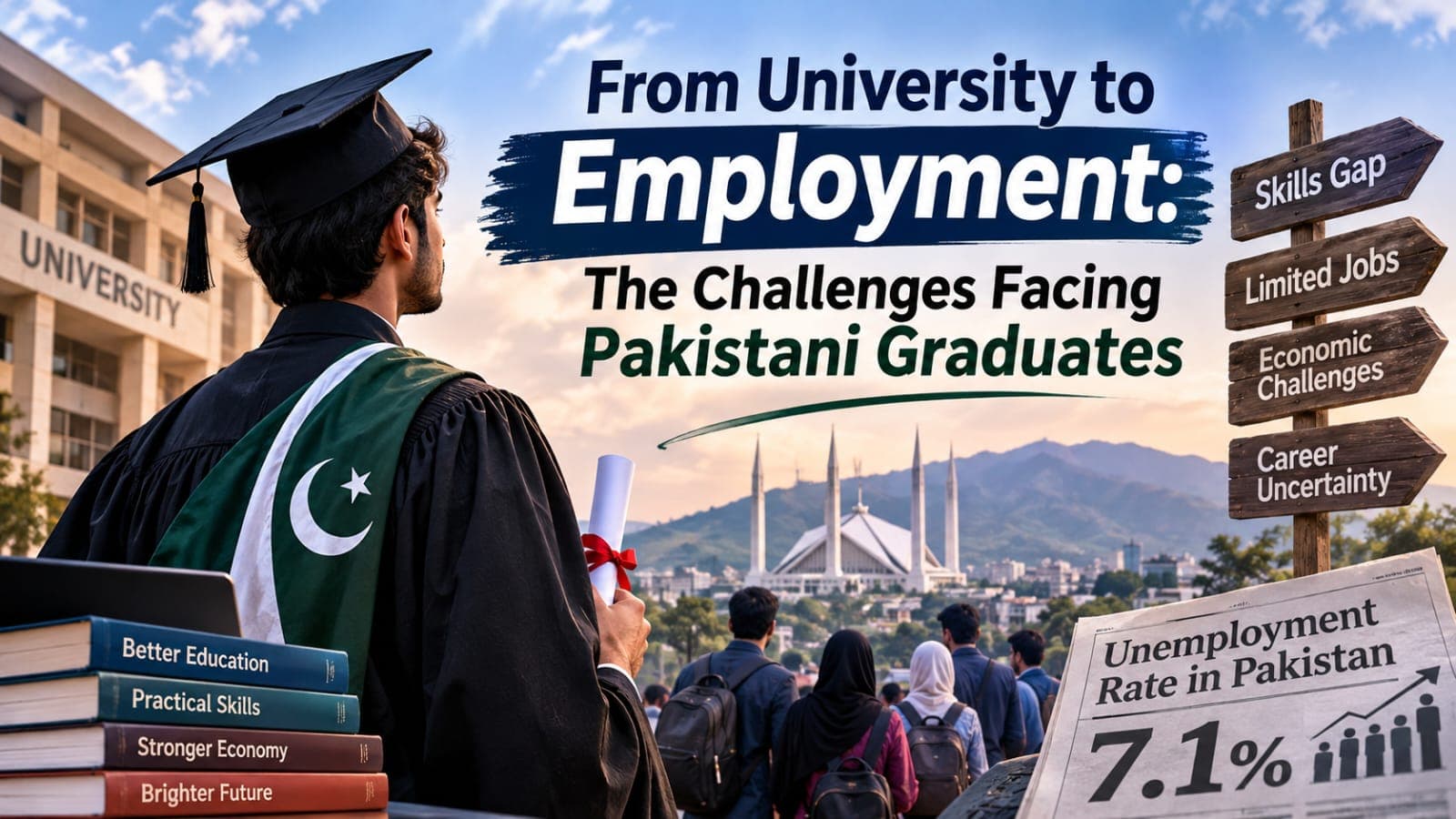
From University to Employment: The Challenges Facing Pakistani Graduates
For many young Pakistanis, completing a university degree is seen as an important step towards building a successful career. Years of study, financial investment and personal effort often come with the expectation of finding suitable employment after graduation. However, the transition from university to the job market is not always straightforward. Some graduates struggle to find opportunities that match their qualifications, while others face difficulties because of limited practical experience, changing employer requirements and competition for available jobs. These challenges raise important questions about the relationship between higher education and employment in Pakistan.
Are universities adequately preparing students for professional life, or do broader economic and labour market conditions play an equally important role?
Graduate Employment in Pakistan: What Do the Statistics Show?
The employment challenges facing Pakistani graduates are reflected in the country's latest labour market statistics. According to the latest available survey from Pakistan Bureau of Statistics' Labour Force Survey 2024–25, the national unemployment rate stood at 7.1%, while unemployment among young people aged 15–24 reached 12.9%. The survey also reported an unemployment rate of 10.8% among degree holders and 11.7% among people with master's, MPhil or PhD qualifications. Although unemployment among degree holders declined from 16.3% in 2020–21 to 10.8% in 2024–25 under the comparable survey methodology, finding suitable employment remains a challenge for many educated Pakistanis.
The figures also reveal differences between men and women. The survey found that unemployment among women with degree-level or higher education reached 23.9%, highlighting the particular difficulties educated women face in entering the workforce. These statistics suggest that obtaining a university qualification does not automatically lead to employment. However, graduate unemployment cannot be attributed to universities alone, as the availability of jobs, economic conditions and employer requirements also influence graduates' opportunities.
The Gap Between Academic Education and Workplace Skills
One of the challenges facing Pakistani graduates is the gap between what they learn at university and the skills employers expect in the workplace. While universities provide academic knowledge, some graduates enter the job market with limited practical experience, technical skills or professional competencies. A 2025 study involving 500 graduates from ten Pakistani universities and 50 employers found that 72% of the employers surveyed expressed dissatisfaction with graduates’ readiness for work. The study also identified communication, problem-solving, digital literacy and practical experience as important factors influencing employability.
The challenge is also visible in Pakistan's technology sector. According to the Pakistan Software Houses Association's (P@SHA) Skills Survey 2025, its member companies hired 13,350 fresh graduates in 2024, compared with an estimated annual output of approximately 73,000 computer science and IT graduates. However, this does not mean that the remaining graduates were unemployed, as some may have found opportunities outside P@SHA member companies, pursued further studies or entered other fields.
Recognising the need for stronger connections between education and employment, the Higher Education Commission announced in September 2025 that supervised internships carrying at least three credit hours, along with industry-relevant professional certifications, would become mandatory components of undergraduate degree programmes. These measures reflect efforts to make university education more closely aligned with workplace requirements. However, improving graduate employability will also depend on how effectively universities develop practical skills and respond to changing industry needs.
Limited Internships and Practical Experience
Practical experience is essential for helping graduates move from university education to professional employment. Internships allow students to apply their knowledge, understand workplace expectations and develop skills that cannot always be learned in classrooms. However, securing meaningful internships remains difficult for some Pakistani students, particularly those with limited financial resources.
The Higher Education Commission (HEC) requires undergraduate students to complete six to eight weeks of practical training, carrying three academic credit hours. In October 2026, Parliamentary Secretary for Federal Education Rabia Naseem Farooqi informed the National Assembly that all 282 universities in Pakistan offered internship opportunities. However, lawmakers raised concerns about the availability of placements and additional charges imposed on students.
Financial barriers can also limit access to practical training. Unpaid internships often require students to cover transportation, accommodation and other expenses, making participation difficult for those from low-income families. Moreover, completing an internship does not necessarily guarantee valuable experience if students receive limited supervision or few relevant responsibilities.
Addressing these challenges requires stronger cooperation between universities and employers to provide accessible, affordable and well-supervised internships. Such opportunities could help graduates develop professional confidence and improve their readiness for employment.
Employment Opportunities and Economic Conditions
The difficulties Pakistani graduates face in finding employment are not limited to their qualifications or professional skills. The country's economic conditions and the availability of suitable jobs also influence their chances of entering the workforce. Even well-qualified graduates may struggle when businesses have limited capacity to expand or recruit new employees.
According to the Pakistan Economic Survey 2025–26, Pakistan's labour force reached approximately 83.1 million people, of whom 5.9 million were unemployed, based on the Labour Force Survey 2024–25. Meanwhile, the Pakistan Bureau of Statistics revised the country's economic growth rate for FY2025–26 to 3.65% in October 2026. Although economic growth creates opportunities, it does not necessarily translate into sufficient professional jobs for the growing number of young people entering the labour market.
Limited private investment, uneven industrial development and competition for vacancies can further restrict employment opportunities. Graduates may consequently accept positions outside their fields of study, pursue additional qualifications or consider employment abroad.
These conditions highlight an important distinction: graduate unemployment is not always the result of inadequate university education. Improving employment prospects also requires sustained economic growth, business expansion and greater investment in sectors capable of creating skilled jobs.
The Role of Universities and Employers
Improving graduate employment in Pakistan requires cooperation between universities and employers. Universities must provide quality education while ensuring that their academic programmes remain relevant to changing industry requirements. Regular curriculum reviews, career counselling and collaboration with businesses can help students prepare for professional careers.
Pakistan's Higher Education Commission (HEC) has introduced measures to strengthen university-industry connections, including supervised internships and professional certifications in undergraduate programmes. However, employers also have an important responsibility in supporting fresh graduates.
Many entry-level positions require previous experience, making it difficult for graduates to secure their first job. Companies can address this challenge by offering graduate trainee programmes, on-the-job training and opportunities for professional development.
Stronger partnerships between universities and industries can help align academic education with workplace expectations. Nevertheless, improving graduate employment requires more than educational reforms alone. Employers must also create opportunities for young professionals to enter the workforce and develop their skills.
What Could Improve Graduate Employability?
Improving graduate employability in Pakistan requires reforms in both education and the labour market. Universities should update their curricula, strengthen practical learning and focus on digital literacy, communication and problem-solving skills.
In June 2026, Pakistan's Ministry of Planning directed the Higher Education Commission (HEC) to review degree programmes and align them with emerging fields, including artificial intelligence, data science and biotechnology.
Career counselling should also help students understand employment trends and choose suitable career paths. Employers can contribute by offering entry-level positions and professional training, while government policies should encourage private investment, entrepreneurship and industrial development.
Ultimately, improving graduate employment requires not only better education and relevant skills but also an economy capable of creating sufficient opportunities for qualified young people.
Conclusion
The transition from university to employment remains a significant challenge for many Pakistani graduates. While higher education provides valuable knowledge and qualifications, a degree alone cannot guarantee a suitable job. Limited practical experience, changing industry requirements and insufficient employment opportunities all contribute to the difficulties graduates face.
Addressing these challenges requires a balanced approach that recognises the responsibilities of educational institutions, employers and policymakers. Universities must prepare students for professional life, while businesses and the government need to support the creation of meaningful employment opportunities.